Showing posts with label Aesop's fables. Show all posts

9.01.2010

The Startling Conclusion!


Startling to the greedy woodcutter, that is. Just about everyone else saw this coming.

My next big question – do I give the kids this book now, or hold off on it for a Christmas book? If I give it to them now, it might be a tad more age appropriate. But if I hold off until Christmas, I've got it all finished in September – WooHOO!

I get the feeling I'm going to break down and just give it to them. I've got some months before December, so I've got plenty of time to put something else together.

8.18.2010

The Woodcutter Story: Several Problems Resolved

This isn't a post about new art per se, although some of that comes into it. It's more about composition and consistency.

In the Frog Prince book, one of the things I liked most about doing it were the split-screen pages, like this one:


But, because of the way the story went, I didn't really have an opportunity to use something similar for the Woodcutter story. But this kind of bugged me. All the pages seemed so... flat. Granted, all pages are, but it was especially noticeable in this one because of the style of art and how little action happens on some of the pages.

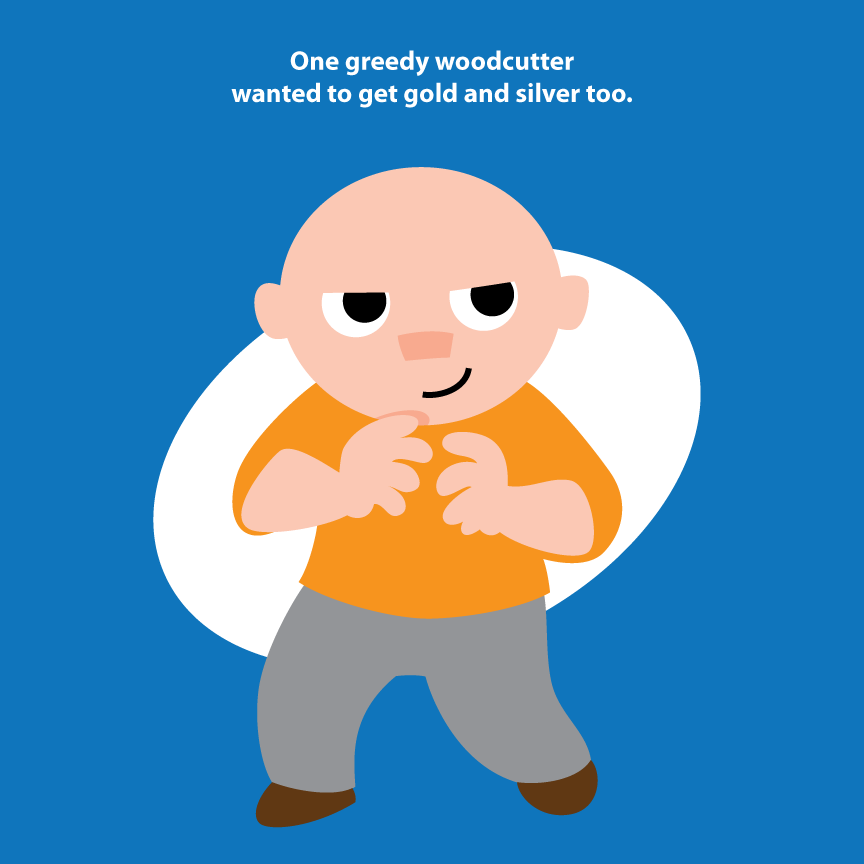
In particular, this page caused the most problems:


It doesn't seem like it would, but it did. Because it's just him standing there. So I got it to where I was happy enough with it, and decided to continue on with other ones. Then, as I was moving along, I got to page 17 (which I'll show in a bit).

On that page, I had to show the bad woodcutter throwing his axe in the water, while at the same time he was pretending to cry. In any other style, I could make this work in a square format. But since the (self-imposed) restraints on the style of this book means I can't use shading, perspective, etc., I was stuck with a composition that was hopelessly horizontal.

The problem was solved, of course, if I could break it up like the Frog Prince story. But I hadn't done anything like that so far, so it would look weird in the context of the book, even if I liked it by itself.

Then I remembered the problem page. If I broke that up, along with its companion page, I'd get this in earlier, and fix the page that was bugging me. Here are the two new versions:


And here's the new one that forced me to overcome the composition problem:


They all look similar here, but in the book they'll be separated by a number of pages, like the split-screen ones in the Frog Prince. The only thing I miss in the silver axe page is that I showed the tree he was standing under in the original version. I liked it, but it couldn't carry the whole page, so out it went.

7.15.2010

Meanwhile, Back at the Other Lake...


The one without swans (you'll be seeing more of the swans later, though, the closer I get to finishing it). Still making my way through this – I'd like to finish it soon, so I can move on to an animal story for the kids' annual Christmas book.

6.07.2010

The Story Continues


Oh, those sneaky mermaids. Good thing our hero is so honest.

5.25.2010

Wherein Woe is Expressed and a Mermaid Enters


Back to the pages. This one is different than The Frog Prince for me. For some reason, it was easy to come up with Moy Moy's expressions on computer. But for Gavin, I need to sketch it out first, scan it in, and trace it on screen. Every page I do this, while for The Frog Prince I think I drew 2 rough sketches for the whole book. I'm not sure why; maybe without a floor-length dress, the main character shows more body language, which I can render best in pencil first.

Below is an example from an upcoming page:


I like the looseness of pencil. But the bright colors and shapes are better for a toddler book, when it comes down to a finish.

The Joy of Computer Art

Ordinarily, I'm much more a fan of traditional art. I like getting in there and really working with the media, in a drawing sense even more than painting.

But sometimes, it's really great to have done something on computer.

The current story being a case in point. When I was in art school, David Macaulay spoke about the process of creating children's books. And what stuck with me the most was that the illustrator shouldn't draw the book from start to finish, because your facility with drawing the characters will improve as you go along. If you go from the beginning on, this change will be obvious to the reader. If you jump around so you've created the illustrations out of order, this isn't nearly as noticeable.

With my hand-drawn work, I've found this to be incredibly good advice.

Now to the computer part. I've definitely noticed that I'm doing this with the Woodcutter in this book. I've gotten into a way of drawing him that I really like. So when I went back to look at page one, I could see that the character was waaaay off. Features too small, head too round.

With traditional illustration, this would mean doing it all over again. On computer, I cut and pasted the head I liked, and now they all look consistent. Took all of five minutes. Glorious.

Here's a side-by-side comparison:

5.24.2010

Out of the woods and back to the woodcutter


A couple more pages, with art advice by Serena again. Thanks to her pointing it out, I saw that I got a bit off style with the original pages 2 and 3. So not only are those are gone, but changing it made the story move along a lot quicker as well. So another round of thanks are due to my lovely wife.

Someday, as my delusions of grandeur assure me, when my fairy tale books are studied by doctoral students, I'll release the first drafts so people can see my working process. But here in reality, I'll just post these.

5.07.2010

The Woodcutter and the Mermaid – It Begins!


With the Woodcutter, of course. This is actually my second attempt at this first page. In the first one, I was trying to draw a caricature of my son Gavin, while keeping it in the same style. I made sure I worked it over and over, to get it as carefully crafted as I could.

Then, when I showed it to my wife, she said it had no life to it.

Now, this might sound like she's being critical, but as soon as she said it, I knew she was completely right. So I went back to the drawing board, thought happy instead of clever, and ended up with this sprightly fellow.

To sum up: these things are a lot more fun, thanks to Serena. But then again, everything is a lot more fun for the same reason, so no surprise there.